


Mudroom Organization in Houston When You Don’t Actually Have a Mudroom
Home Organization · Houston TX
Every mudroom post on the internet is written for a house that has a mudroom.
The floor plan promised you a drop zone. What it delivered was a hallway. There’s a back door, a laundry nook, a door in from the garage, and no actual room to land in. So the backpacks end up on the dining chairs.
I work in Houston homes every week, in West University, The Heights, River Oaks and Spring Branch, and this is the single most common layout problem I see. Which means mudroom organization in Houston is almost always a conversation about a house that doesn’t have one. And not having a mudroom doesn’t mean you can’t make one. You just have to put it somewhere the house didn’t plan for.
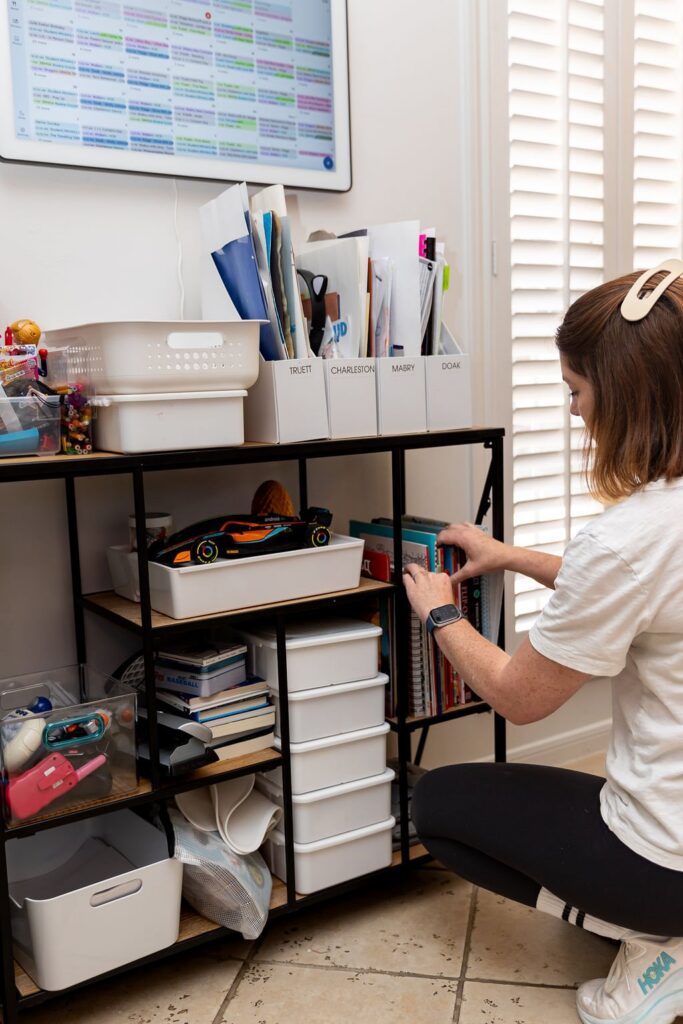
We bought new construction. There was still no mudroom.
People assume this is an old-house problem. It isn’t. We moved into new construction. Nobody had lived in it before us, we picked it out, and there was no mudroom anywhere in the plan.
The square footage went to the kitchen island and the primary closet. The place where four people actually walk in every day got a light switch and some drywall.
So if you’ve been assuming you’re the problem here, you’re not. The house didn’t plan for this. That’s a gap in the floor plan, not a flaw in you, and a gap in a floor plan has answers. Mine is a drop zone I built on purpose, in a spot the builder had no plans for.
Not having a mudroom doesn’t mean you can’t make one.
Where your family already drops things is information
Before you buy a single hook, watch your house for a week. Where do the shoes actually come off? Where does the backpack actually land? Not where you wish it landed. Where it lands.
That pile is not a character flaw. It’s data. Your family already voted on where the drop zone goes, and they voted with their feet.
Then look at how it lands, because that’s the half everybody skips. A backpack on the floor under an empty hook is telling you the hook is too high. A jacket that makes it as far as the bench and never to the closet is telling you the closet is one step too far. And if the whole thing falls apart at 3:15 every day with a three year old melting down on the floor, the system isn’t the problem. You’re asking a tired kid to do four things in a row with no help, and no amount of labeling fixes that.
A backpack on the floor under an empty hook is telling you the hook is too high.
So the question I’m asking in a planning meeting isn’t only where does this go. It’s what is actually happening right here, and how do we make it easier for the person who keeps not doing it.
Then put the zone as close to the door they come in as the house will allow. Every extra step is a step a seven year old will not take while holding a lunchbox, a library book and a soccer cleat.
The only real choice left is whether you want to look at it. Plenty of my clients want it out in the open by the door, and that’s the easier build, because visible is a large part of what makes it get used. Others would rather not see it, and for them a closet is the answer. What doesn’t work is putting it somewhere inconvenient because that’s where there happened to be room.

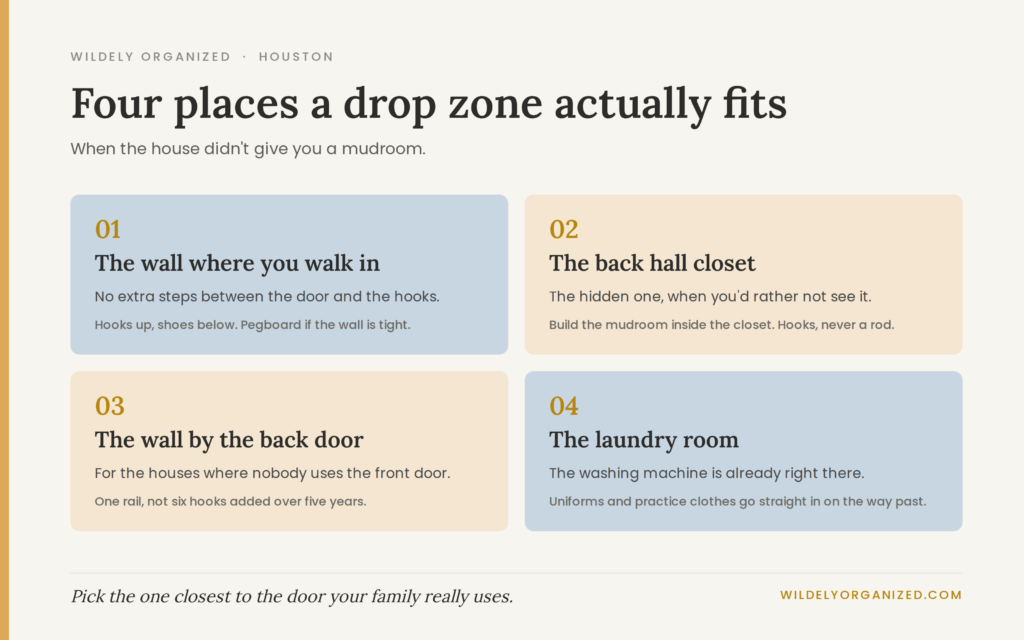
The four places a drop zone actually fits
Every house I walk into has at least one of these. Pick the one closest to the door your family really uses.
1. The wall right where you walk in
The best answer when you can get it, because nothing stands between the door and the hooks. Hooks up, shoe storage below. If the wall is short, a pegboard adds surface without eating floor, and an antique dresser under the hooks does the same job while reading as furniture instead of storage.
This is the one I have. Backpacks hang, shoes go on the rack, and the sports bags live on their own hooks out in the garage, because that’s the direction they’re headed anyway.
2. The back hall closet
The hidden version, for when you’d rather not look at the drop zone from the kitchen. Don’t treat it like a closet. Build the mudroom inside it.
One of my clients has the best version of this I’ve built. Backpack hooks and a pegboard on the inside wall, a shoe bin on the floor, and back stock of what she’s always grabbing on the way out, sunscreen and AirPods included. She also keeps travel items in there, the things that keep her kids busy at a restaurant, packed and ready so they leave the house with them instead of remembering in the car.
3. The wall by the back door
Same build as the entry wall, for the houses where nobody uses the front door. This one is usually visible from the kitchen, so it has to look deliberate, which mostly means one rail instead of six mismatched hooks added over five years.
4. The laundry room
Same build again, with one advantage nothing else has. The washing machine is standing right there, so uniforms and practice clothes go straight in on the way past instead of taking a lap through a bedroom floor first.
The routine that runs on top of whichever spot you pick is its own post. This one is about where the zone goes.
The Houston problem nobody writes about: the coat closet
Every mudroom article written outside of Texas is about coats. Coats, winter gear, snow boots, a place for the wet mittens.
I’m writing this in September and it’s a hundred degrees outside. What my clients need a landing spot for is the pool bag. Sunscreen, by the door instead of upstairs where nobody will go get it. A towel, because my husband comes back from a run looking like he jumped in a pool. Houston drop zones hold different things than the ones in the photos, and they should be built for what we actually carry.
Which brings me to the coat closet. Most houses here still have one by the door, holding four coats nobody has touched since February, in the exact square footage the drop zone should have.
You don’t need a coat closet in Houston. You need a place to put the things you carry every single day.
So take it. Move the coats to your bedroom closet, where four coats won’t be a problem. Then change what’s inside, because one rod up high with a shelf above it isn’t a mudroom. That’s a design for somewhere with real winters and giant boots by the door, and we have neither.
Take the rod out and put in hooks. Not a lower rod. Nobody hangs anything on a hanger on the way in the door, including me. Hooks, a shoe rack on the floor, and a bin or two for the pool bag and the sunscreen. That’s your mudroom, and in most Houston houses I walk into it’s the biggest swap available.
What changes in the fall
Fall is when the drop zone breaks, and it breaks the same way every year. Right now I have a kid playing football, baseball and soccer. Seasons overlap, the gear doubles, and the zone that held all summer is suddenly carrying four bags.
My rule is a bag per sport. It sounds like a lot of bags. It is a lot of bags, and you almost certainly already own them. My oldest uses his old baseball bag as his football bag. We didn’t buy anything. One bag per sport means the cleats, the socks and the mouthguard stay together, and nobody is hunting for a shin guard at 6:40 in the morning.
The other thing to do in October, before you need it, is pull the cold weather sports gear out and put it with the bags. The first cold snap here arrives on a Tuesday with no warning, and every year everybody is freezing on the sideline because the long sleeves are in a bin in the attic. Ten minutes now and you’re covered.
Past that, the swap here is small. Trade the raincoat for the jacket and decide what earns a hook for the next three months. Every hook is a parking space and there are only so many. If the swim bag is still hanging there in November, it’s holding a spot the soccer bag needs.
What this looks like in my own house
I don’t have a mudroom. I have a drop zone for my kids’ things, and a spot in the kitchen that’s mine, because the person running the house needs a landing place too and usually doesn’t get one.
Mine is also a little spread out, and that’s fine. The sports bags live out in the garage on their own hooks. My kids pack their own bags. If you forget something, that’s on you, not on me. I will remember to put the bag in the car. I will not remember to put your glove in the bag.
My kids are 4, 7 and 9. They come in from the afternoon and they know exactly what to do. Bags go on their hooks, shoes go on the rack. They’re not unusually tidy children. They have a list, I taught them the list the way I’d teach anything, and we’ve run the same routine for years. My four year old has never known a house that worked another way. Here’s what it looks like on a real afternoon.
I still have to tell them to start. Every single day. What I don’t have to do is tell them what comes next or where anything goes, and that’s the whole difference between a system and a person doing all the remembering.
And plenty in my house doesn’t hold. The lunch containers are a mess right now. But the thing I’d actually point at is this: my playroom gets reset and rethought constantly, because my kids keep changing ages and what they play with changes right along with them. The drop zone doesn’t. It’s the one space that grows up with the family.
You don’t need a new drop zone because your kids got older.
You might need bigger sports bags eventually. That’s nothing next to rebuilding a system.
Questions I get about mudroom organization in Houston
What if the only way in is through the garage?
Then that’s your spot, and you build it on the first wall inside the door. Not out in the garage. Houston garages get hot, humid and gross, and anything you care about will not survive out there. The one exception at my house is sports bags, which are already filthy and already headed to the car.
Do I actually need a bench?
Probably not. We have one only because it was already there, and nobody in my house has ever actually sat on it. A bench turns into a shelf for things nobody put away, and it costs you the floor space the shoes needed. Get one if your family genuinely sits down to take shoes off. Most don’t.
How do I stop it becoming a dumping ground?
Two things. Cap it, so it’s one hook per person and nothing lives there that isn’t carried in and out most days. A drop zone fails when it turns into storage and works when it stays a parking lot. Then hold the line. If a backpack isn’t where it belongs, send them back to finish it. It isn’t one and done, and that’s how it turns automatic.
What if there’s no wall? My door opens straight into the living room.
Then split it up. Shoes come off right where they walk in, because that’s the one habit worth putting at the door and the easiest one to build. We have a shoe shelf behind our couch and that’s where my kids’ shoes go. Two bins on the floor works just as well. Then let the backpacks move a few steps further in, wherever there’s room. The pantry is a good one. You give up the all-in-one-spot look and keep the part that matters, which is that the shoes never hit the middle of the floor.
What does it cost to set one up in Houston?
I can give you a general estimate on our first phone call, and a much more solid one at the in-home planning meeting once I have seen the space. A drop zone is one of the faster projects I do. If you want the full picture on how pricing works, I have written about that here.
No mudroom? Let’s build you one anyway.
I’ll find the spot your family already uses and build a drop zone the whole house can run, not just you. Let’s start with a free phone call.
Book a free callJordan Wilde is a professional home organizer and the owner of Wildely Organized, serving Houston families in West University, The Heights, River Oaks and Spring Branch. A former teacher and a mom of three, she builds whole-family systems, not just systems for mom, so everyone in the house knows where things go. More on how that works here.
