


The After-School Routine That Actually Sticks
Family Flow Systems · Houston TX
Right now you’re the system. Every afternoon, you’re the one holding it together. That’s the part we can fix.
Here’s what happens in a lot of Houston houses at 3:15. The door opens. Backpacks hit the floor. Shoes go one under the couch and one somewhere nobody will find until Thursday. A lunchbox stays in the bag until it smells. And you, standing in the kitchen, start issuing the same six instructions you issued yesterday.
Then you do it again the next day. And the next. For nine months.
I’m Jordan. I’m a professional home organizer in Houston and I run Wildely Organized. I build whole-family systems, meaning systems everyone in the house can use, not just mom. I’m also a former teacher and a mom of three (ages 4, 7, and 9).
The first thing I tell every client is don’t clean up before I come. I want to see the real 3:15, not the version you staged for me. Your house being a wreck is not information I need protecting from. It’s the whole reason I’m there.
So. Here’s the after-school drop zone I set up in client homes every August, and the six-step routine that runs it. It takes about twenty minutes. It is not pretty. It works.
If you’d rather skip the article and just take the printable checklist, go ahead. I won’t be offended.
Why the cute chart dies by October
Every August, somebody buys a cute chart. It goes on the fridge. It survives about eleven days.
That’s not a discipline failure. The chart was built wrong.
It lives in the kitchen, but the mess happens at the front door. It says “put away your things,” which is not an instruction, it’s a wish. And it assumes the kid can reach the place the thing goes, which, in a lot of houses, they can’t.
If your seven-year-old has to ask you where something goes, that’s not a behavior problem. Nobody told the house where things go yet.
A routine that sticks is posted where the action happens, uses steps a kid can picture, and lands everything within reach of the shortest person who has to use it. (I went deeper on the ways these routines go wrong in the three mistakes that cause after-school chaos.)
That’s the trick. It isn’t motivation and it isn’t a reward chart.
The six-step after-school routine
Six steps, in this order. Order matters. Shoes come off after the backpack is hung, not before, or you get a barefoot kid standing in the driveway holding a lunchbox.
Step six is not filler. Step six is the point. The routine ends in the thing the kid actually wants, which is why they’ll run it. Nobody finishes a checklist that ends in “now do your homework.”
This is the list. Do you want it on paper?
One page per kid. There’s a picture version, so a three-year-old who can’t read yet can still run it. Print it, tape it by the door tonight. It’s free.
Give me your email and I’ll send it right over. Fair warning: you’ll also land on my list, which is where I write about making a house work for the people in it. No pitches. Unsubscribe in one click and I will never know.
SEND ME THE CHECKLISTThe paper. Let’s talk about the paper.
Everyone focuses on the lunchbox. The lunchbox is not what’s eating your counter.
What’s eating your counter is paper. Graded worksheets. The permission slip. The reading log. The fundraiser envelope that has to go back by Friday. A drawing you are not allowed to throw away and also cannot keep four hundred of.
If step two just says “unpack the backpack,” the paper comes out of the bag and dies on the counter, and now you have a pile. And nobody knows what’s at the bottom of a pile, which is why the pile keeps growing instead of getting dealt with.
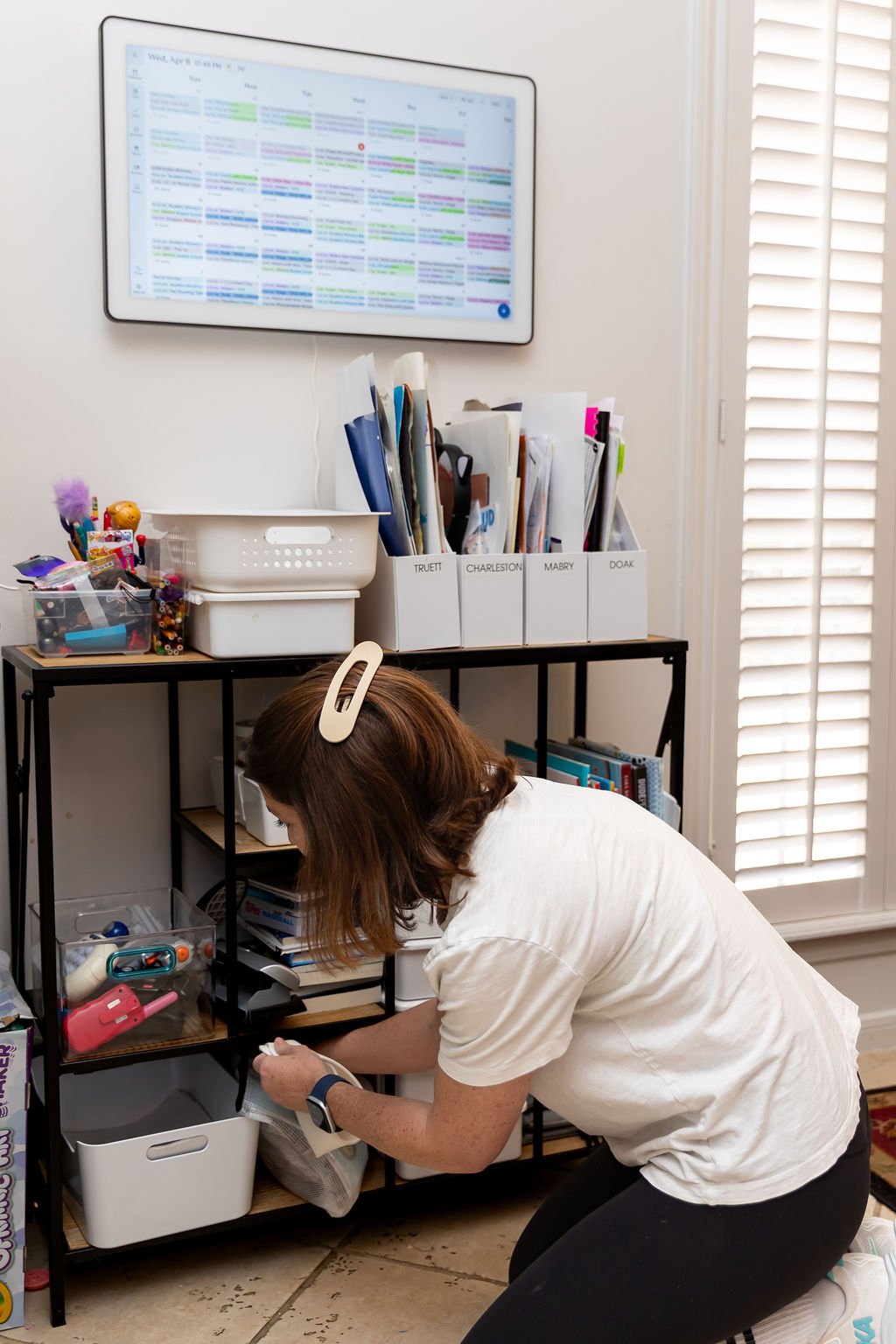
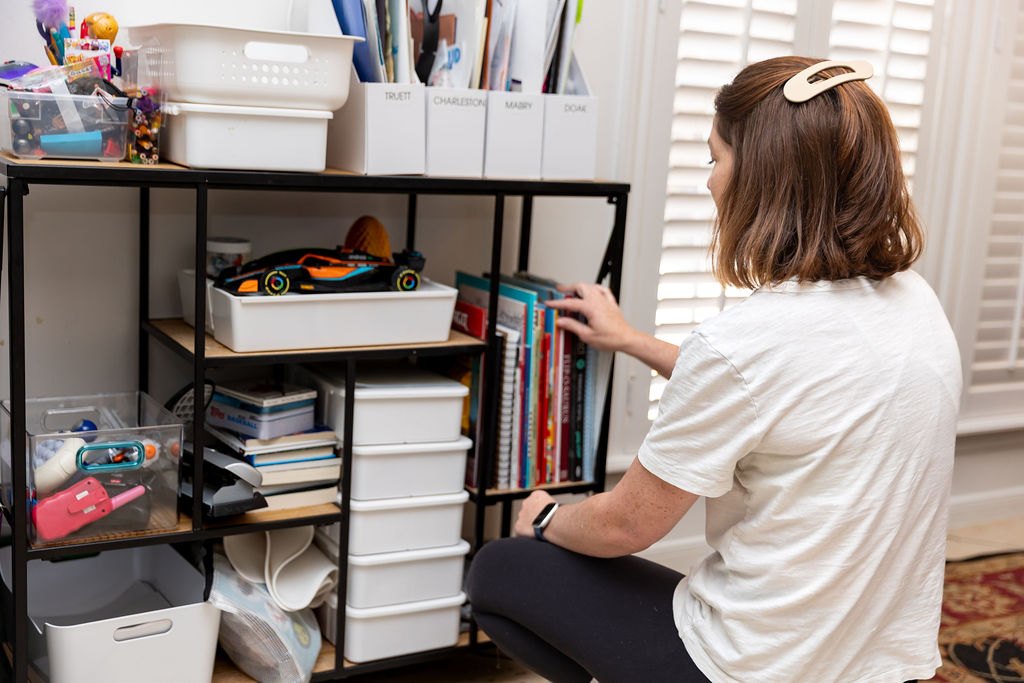
So step two has a third part: papers go in the paper spot. One tray, one basket, one folder. It doesn’t matter what it is. It matters that it exists and that the kid can reach it.
Then you deal with the paper spot once a week. Not every day. Once.
Sunday, five minutes, standing up. Sign the things. Recycle the things. Put the drawing you’re keeping in the keepsake bin. The point is not that the paper disappears. The point is that it lives in one place and gets handled on a schedule instead of ambushing you at 7am when someone needs a signature.
“Okay, but what do I do when they just walk past it?”
This is the real question and most people writing about routines never answer it. So here’s the honest version, from a former teacher who has watched a lot of children ignore a lot of instructions.
You point. You don’t nag.
They walk past the list, you don’t recite the six steps. You walk over and you point at the list. That’s it. No lecture, no countdown, no negotiation.
The reason this works and yelling doesn’t: the moment you say the steps out loud, you have become the checklist again. You’ve taken the job back. Pointing keeps the job on the wall where it belongs, and it is extremely boring, which is the point. Nobody wants to fight with a piece of paper.
You do it every day for longer than you want to.
Not a week. Weeks. My youngest started this list when she was two and she could not read a word of it, so I walked it with her every single afternoon. Out loud, all six steps, over and over, while I was also making dinner and refereeing the other two. I’m not going to pretend that was nothing. It was tedious and I did it anyway, because the alternative was doing it forever.
Eventually she stopped needing me. Not because she’s a remarkable child, but because she’d heard the sequence three hundred times, the way kids learn the words to a song nobody sat them down and taught.
That’s the whole mechanism. It isn’t reading and it isn’t maturity. It’s repetition, plus a hook they can reach.
You accept that the 5:45 version is different.
If you’re getting home at 5:45 after soccer, in the dark, holding a sleeping toddler, you are not running a six-step routine. Nobody is.
On those days, do steps three and four. Backpack up, shoes away. That’s it. Those two are what turn tomorrow morning from a search party into a normal morning. The other four can wait.
A system you can do a two-step version of on a bad day is a real system. A system that only works on your best day is decoration.
Setting up an after-school drop zone in a Houston home
A hook. A shoe spot. That’s the list.
At my house it’s hooks on the wall and a bin for shoes. Done. I didn’t build anything, I didn’t buy a system, and there is nothing matching about it.
People stall out here because they think they need a mudroom first, or the right bins in the right finish. You don’t. You need a place for the bag and a place for the shoes, both low enough that a kid can use them without calling for you.
I’ve set this up in a River Oaks house with a purpose-built drop zone, and in a West University bungalow with three hooks screwed into the back of a door. The bungalow version works exactly as well.
The hook doesn’t know how much it cost.
When I do this as a session, in The Heights or Spring Branch or anywhere else in Houston, most of the time we’re using what’s already in the house. I bring products when there’s a functional reason to, and I only charge for the ones we actually use. You can see what that looks like in real homes here.
This is the part that makes it a whole-family system
Here’s what happens once the list is on the wall and the hooks are at kid height: you stop being the only person who knows how the afternoon works.
Your husband does Thursday pickup and doesn’t have to text you asking where the lunchboxes go. The babysitter can run it. Your mom can run it when she’s got the kids. The new nanny can run it on day one.
That’s the actual product. Not a tidy entryway. The fact that the information leaves your head and goes on the wall, where anyone can use it.
Because right now, in most houses I walk into, one person is the operating manual. And she’s tired.
The part nobody tells you: it will still break
Some afternoons my kids blow straight past the list. Somebody’s tired, somebody’s got a friend over, somebody just doesn’t feel like it. The routine does not turn your children into small compliant robots and I would be suspicious of anyone who tells you it does.
The house is going to get messy. That’s not the problem. The problem is when the mess doesn’t bounce back.
What the routine buys you is recovery. On a bad day the entryway looks like a bomb went off. But because everything has a home, and because the kids know where the homes are, a bad day takes four minutes to undo instead of becoming Saturday’s project.
That’s the actual measure of a good system. Not whether it’s spotless. Whether it bounces back.
So if week one is a mess, that tells you nothing. Check again in October and ask one question: does anyone besides you know where the shoes go? If the answer is yes, it worked.
Questions people ask me about the after-school drop zone
Is there a printable version of this routine?
Yes. Free, one page, with a picture version for kids who aren’t reading yet. It costs you an email address, and you’ll land on my list, which you can leave any time. Send it to me.
What age can a kid start following an after-school routine?
As soon as they can hang up a backpack. That’s the whole bar. Forget age. My youngest started at two, and I walked the steps with her out loud every afternoon for months before she could run it alone. The little ones need a picture version and a lot of repetition, not a later birthday.
What do I do when my kid just ignores the checklist?
Walk over and point at it. Don’t say the steps out loud, because the second you do, you’ve become the checklist again and taken the job back. Pointing is boring, and boring wins.
Should I use a reward chart with the after-school routine?
I don’t. Rewards turn the routine into a negotiation, and then you’re managing the reward system on top of everything else. Ending the list with “play” is the reward, and it’s already built in.
Do I need to buy bins and organizing products for a drop zone?
No. A hook and a shoe spot per kid is genuinely the whole requirement. When I work with families in The Heights or Spring Branch, we usually use what’s already in the house. I bring products only when there’s a functional reason, and I only charge for what gets used.
How much does a professional organizer cost in Houston?
Houston organizers generally run somewhere in the $75 to $150 an hour range, and most charge separately for the first in-home visit. I start with a free phone call, so you can find out what your project would actually involve before anyone quotes you a number. Nobody should be surprised by a price. I broke the whole thing down in what a professional home organizer actually costs in Houston.
How long does it take to set up an after-school drop zone?
About twenty minutes on your own, if you already know where things should go. As a session, a full entryway and mudroom usually runs three to four hours, because we’re also dealing with everything that’s been piling up in that space since last spring.
Do you work with families outside central Houston?
I work with families across Houston, mostly in West University, The Heights, River Oaks, and Spring Branch. If you’re nearby and not sure whether you’re in range, just ask on the call.
Take the checklist. Tape it by the door tonight.
Free, one page per kid, picture version included. Costs you an email address, and you can unsubscribe any time.
SEND ME THE CHECKLISTWant the whole entryway sorted before the 18th? Book a free call. And don’t clean up before I come.
Jordan Wilde is the owner of Wildely Organized, a home organization company in Houston, TX serving families in West University, The Heights, River Oaks, and Spring Branch. She’s a former teacher and a mom of three, and she builds whole-family systems: spaces that everyone in the house can use and maintain, not just mom.
